02 / Mathematics
My mathematical interests.
ASTRONOMY / CURRENT RESEARCH
Orbital
resonance
In this astronomy project, I use N-body simulations to study how Jupiter changes comet-like orbits.
In a 3:2 pattern, the comet completes three orbits while Jupiter completes two. I investigate how objects near this pattern can later enter 2:3 resonance.
How often do comet-like orbits move from 3:2 to 2:3 resonance with Jupiter?
Method
Following a population of orbits
I run the gravitational simulations in REBOUND and analyse the saved orbital histories. JPL Horizons provides the planetary starting states, and I use REBOUND’s TRACE integrator for the simulation.
H1 and H2 are artificial near-3:2 starting orbits designed as stable and unstable simulation cases, respectively. The latest completed experiment uses the supplied H2 starting orbit. The ensemble contains one nominal orbit and 447 perturbed orbits. These perturbations explore nearby initial conditions.
The model includes the Sun and eight planetary system barycentres. It uses a 0.01-year integration step. The detector checks the motion every 0.5 years.
Identifying resonance
Reading the orbital rhythm
I first screen orbital-period ratios, and I then examine a resonant angle over time. Repeated back-and-forth motion of this angle is called libration. Motion through a full turn is called circulation.
The current screen requires at least two oscillation cycles and 100 years of evidence. It also applies a 5% period-ratio band and a 300-degree angle-span limit. I save the angle histories to examine what happens around each recorded episode.
Latest completed run / 29 October 2026
The H2 million-year experiment
The detector recorded 117 candidate 3:2 episodes and 229 candidate 2:3 episodes. These episodes involved 171 distinct particles.
- Retained at the endpoint
- 111
- Crossed the 1,000-AU removal boundary
- 307
- Collisions
- 30
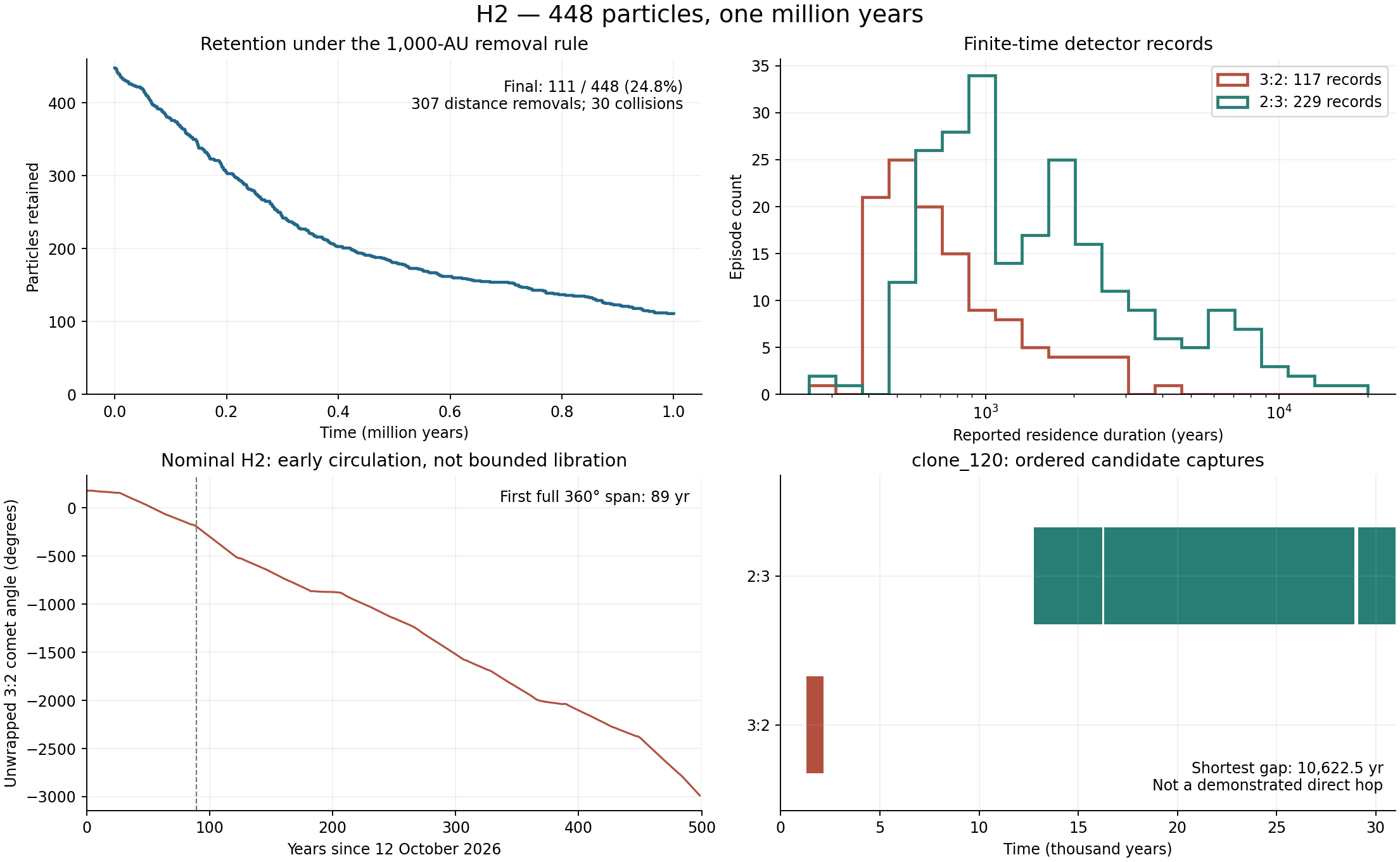
Nineteen particles had a 3:2 record followed by a later 2:3 record. This is 4.24% of the starting H2 ensemble. The shortest gap between such records was 10,622.5 years.
The nominal angle circulates within 89 years, and 446 of 448 particles reach full circulation within 500 years. The 19 sequences describe ordered candidate records in this H2 sample. Estimating a transition probability for initially trapped objects will require a cohort with verified initial libration.
Saved angle histories
Examining individual episodes
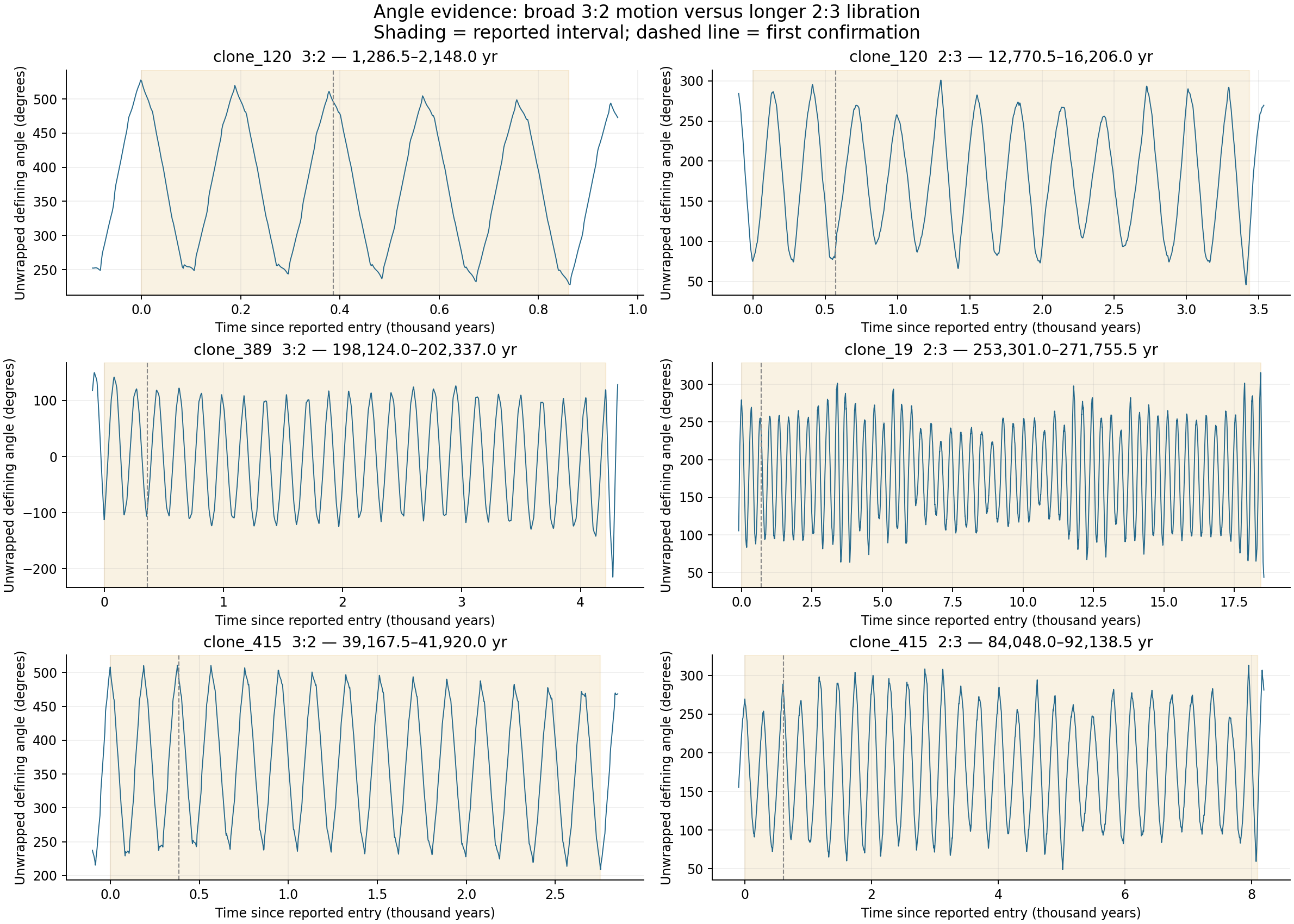
Clone 389 has a recorded 3:2 episode lasting 4,213 years, and clone 19 has a recorded 2:3 episode lasting 18,454.5 years. Their saved angles show repeated oscillations over these intervals.
Detector sensitivity
Checking the record boundaries
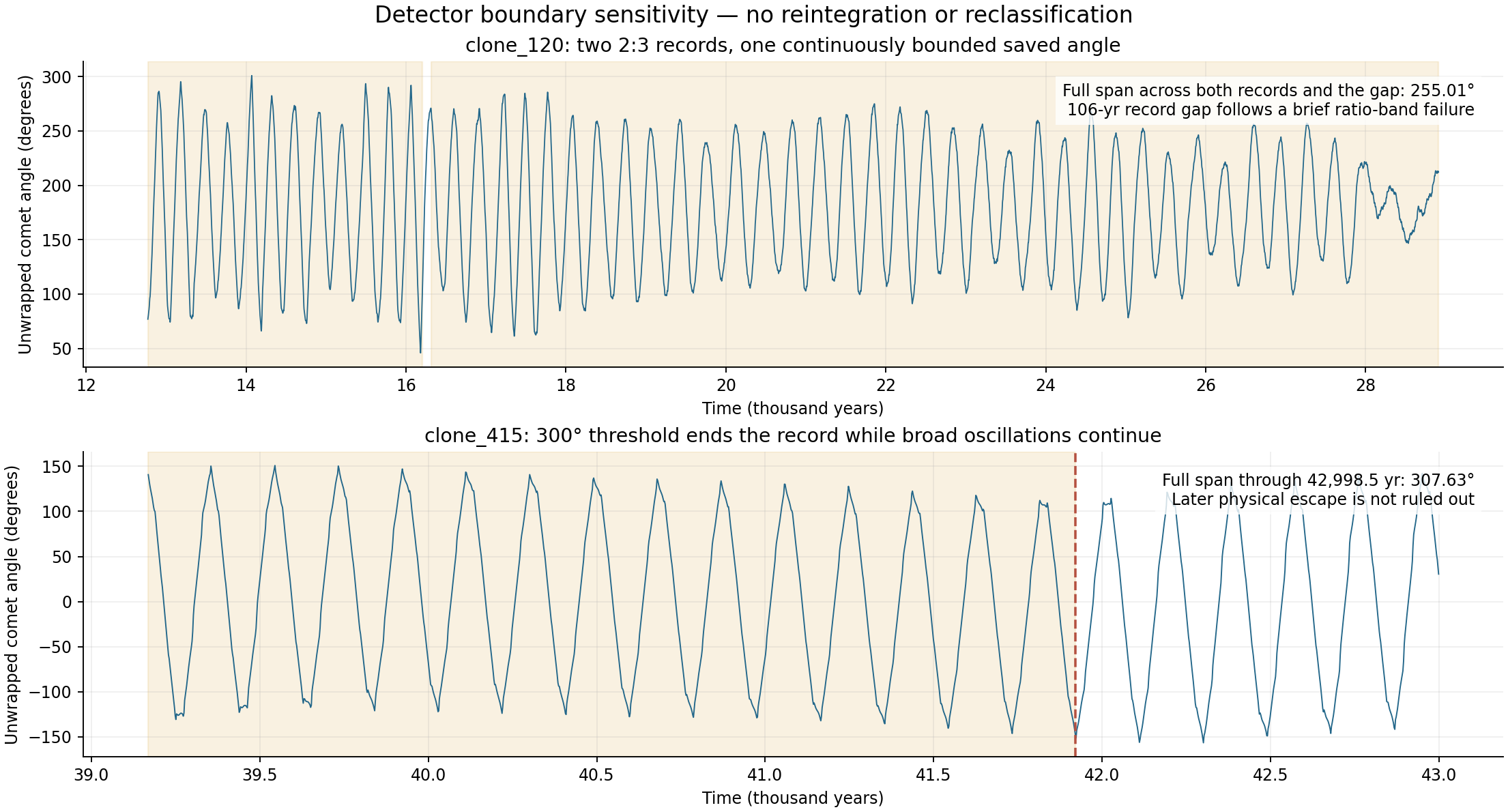
Clone 120 has two 2:3 records separated by 106 years. Its saved angle stays within a 255.01-degree range across the whole interval. The period ratio briefly crosses the detector’s band, and I am examining how these thresholds affect episode counts and durations.
Earlier validation / 25 October 2026
Checking a control orbit
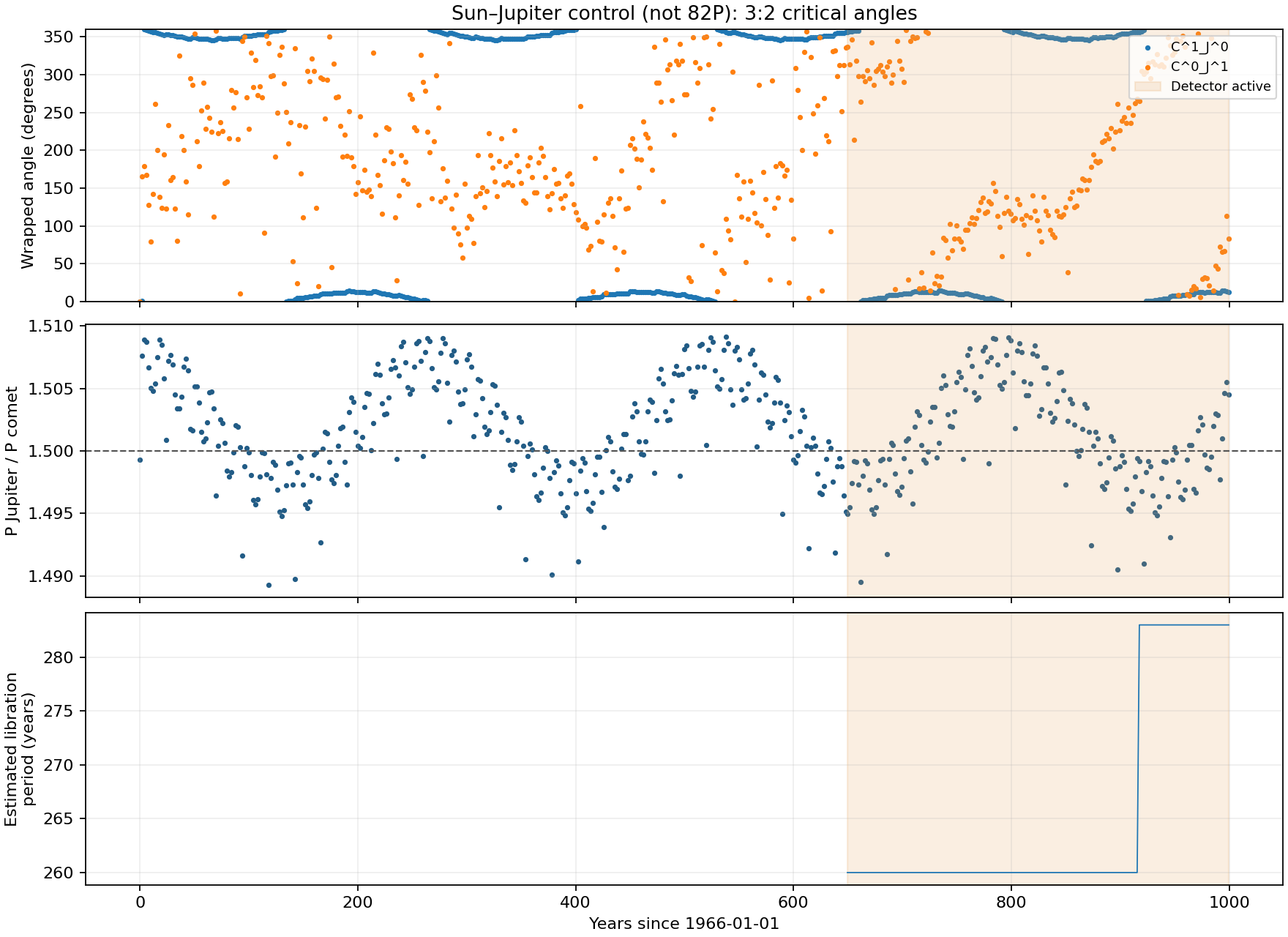
An earlier control run uses an artificial Sun–Jupiter orbit near 3:2 resonance. Its detector remains active at 1,000 years, and its recent full-cycle estimates range from 260 to 283 years.
This control uses the earlier recent-cycle detector. It provides a reference for interpreting the angle plots.
Next experiments
Testing the starting conditions
The next experiments will compare H1 and H2 with matched settings. These cases differ in their initial orbital phase. I will check initial libration over several cycles, and I will repeat selected trajectories with smaller integration steps.
Impact
Why this research matters
Jupiter can redirect small bodies across the Solar System. This project studies how orbital patterns change during scattering, and it connects individual trajectories to population statistics.
The results help identify which starting conditions and detector choices deserve closer study.
Earlier work / Yau Math Camp 2025
Knot colorability
and knot groups
I wrote a paper during Yau Math Camp. The paper focuses on knot colorability. It studies a surjective homomorphism from the knot group to the dihedral group D2n.
I submitted the paper to the Yau Science Awards, and I also gave a talk titled Colorability and Knot Groups.
Study and competitions
Selected milestones
- AIME
- 13February 2026
- SUMaC
- Program ISelected for 2026
- RP2
- Ross online program